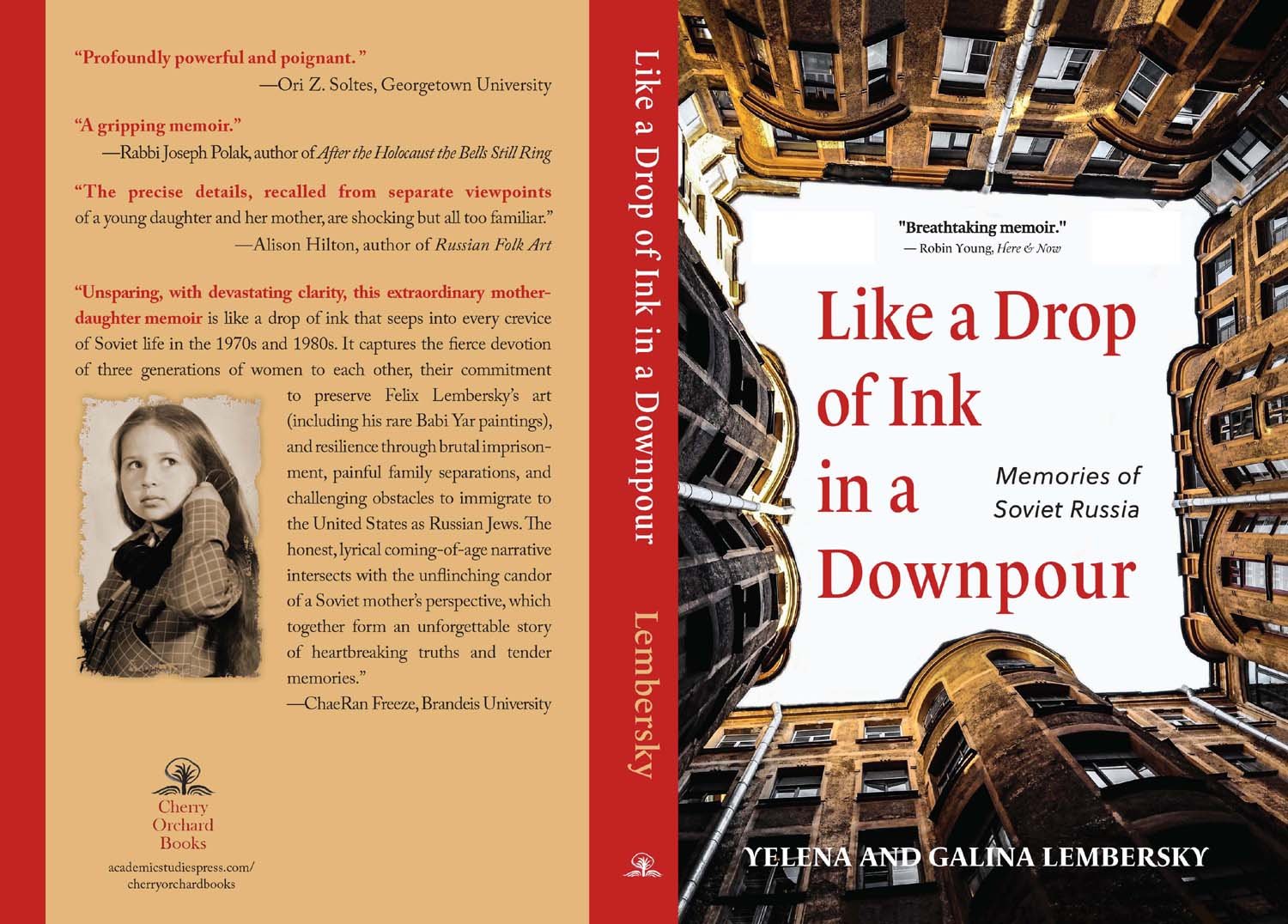
LIKE A DROP OF INK IN A DOWNPOUR
2022 Women’s National Book Association Great Group Reads Selection
2022 Foreword INDIES Book of the Year Awards Finalist
2022 National Jewish Book Award Finalist for Autobiography & Memoir
Like a Drop of Ink in a Downpour is more ambitious than the average memoir. It’s informed by Galina’s and her parents’ lessons on the value of art and culture and enriched by Alëna’s beautifully constructed images and Galina’s poetry.
– Herb Randall, LA Review of Books
Strikes a real chord given the ongoing Russian war with Ukraine.
— Tiziana Dearing, Radio Boston
How did Felix Lembersky’s paintings came to the United States? This memoir follows the lives of the artist’s wife, daughter, and granddaughter in Leningrad, now Saint Petersburg, Russia, in the 1970s and ‘80s. Yelena’s life is upended when her mother, Galina, decides to emigrate to save the paintings by her late father. Instead she is charged with a crime and unjustly incarcerated.
Told in the dual points, this memoir is a clear-eyed look at the reality of life in the Soviet Union during the Cold War, giving us an insider’s perspective on the roots of contemporary Russia. It is also a coming-of-age story, heartfelt and funny, a testament to the unbreakable bond between mothers and daughters, and the healing power of art.
YELENA LEMBERSKY is a co-author of two books, Felix Lembersky: Paintings and Drawings (2009), and Like a Drop of Ink in a Downpour, co-authored with her mother, Galina. Her writing appeared in World Literature Today, The Forward, Cardinal Points Literary Journal, among others, and she was a guest on National Public Radio: Here & Now, and Radio Boston. Yelena curated numerous exhibitions of Felix Lembersky and she speaks regularly about his art at the universities, cultural institutions, and academic conferences. She studied art and architecture at MIT, the University of Michigan, and the Mukhina (now Stieglitz) Institute of Art in Leningrad.
RESPONSES to LIKE A DROP OF INK IN A DOWNPOUR
My parents are from the Soviet Union, and while they talk about it a lot, I was never able to relate to their stories or fully understand them. Their stories seemed so alien to me because of how different they were from my childhood. But after reading [this] memoir and imagining all the small details in my head, like the guy that would go door to door to sharpen knives, I feel that I am closer to relating to my parents' stories.
D. P., student, QUEEN'S UNIVERSITY, Kingston, ON, Canada, 2023
Reading the beginning of this [memoir] made me nostalgic for something I have never experienced: my mother’s childhood. She was born in the same year as Alena in the Soviet Union. I grew up listening to her stories about her childhood and what life was like in the USSR. Reading this section was like reading about my mother. . . . I remember my mother telling me about the government constructions, the alcoholism, the empty shelves in the grocery stores, the propaganda, the neighbors in the housing projects. It is fascinating to experience the Soviet environment through the lens of someone other than my parents. I’m really excited to continue reading.
—P.C., student, University of Michigan, September 2022
Cristina Gonzalez, University of Michigan, Fall, 2022